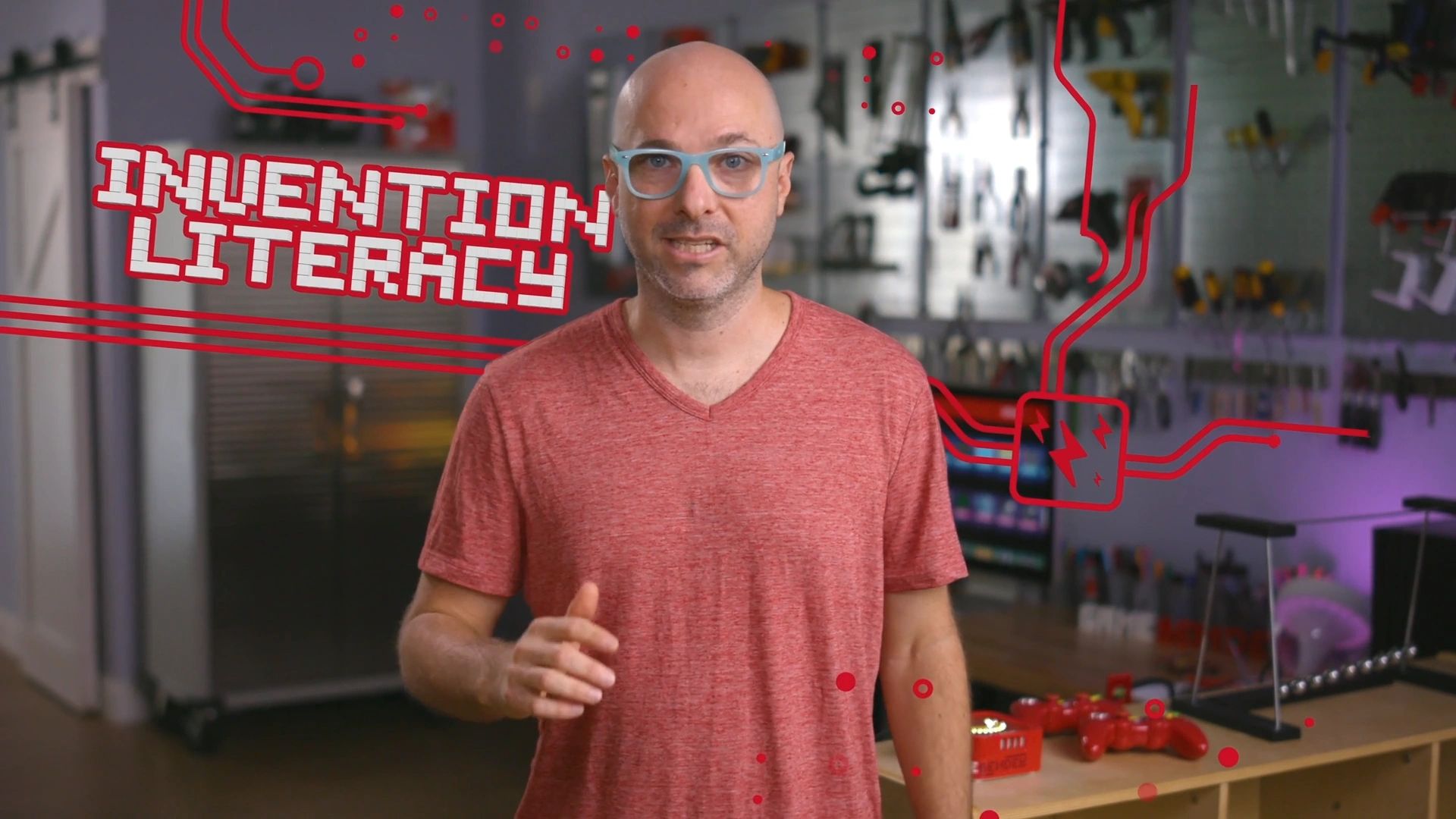
What is Invention Literacy
Invention literacy is the ability to read and write human made stuff, from toasters to apps. People think inventors perform magic, but invention is no more magical than reading and writing a sentence. There is a grammar to inventing from mechanical tools, to design thinking, coding, and beyond. There is a literature of inventions, from bicycles to televisions, all around us to draw inspiration from. Just as Thoreau read Emerson's writings, so too did Edison read Tesla's inventions. The functional pieces of inventions: transistors, bent sheets of aluminum, a "for loop" in software, these are like a large alphabet. As one learns to "sound out the words" of inventing, one begins to see a product not as a "black box" but as a collection of comprehensible pieces which come together to make up a blender, a pair of Nikes, or a ferris wheel. The Adventures of Huckleberry Finn would be incomprehensible to someone who doesn't know the rules of reading English.
Beyond understanding, emotion plays a role too. Words are actually scary to illiterate people. We have to stop thinking of inventions as some unknown future phantoms to be conjured by alchemy. Inventions, from a clay pot to an iPhone, are simply the human-made part of the world that we live in.
Not everyone will be a professional writer, but everyone needs to learn to read a menu and write a text message. Likewise people should graduate understanding how things are made and how to build their own ideas, at least at the proficiency equivalent to writing a 5 paragraph essay. Right now we have single digit invention literacy percentage, and we have an accompanying fear of "how things work." Invention literacy is a hidden literacy, and I'd like to uncover it. It's the true 21st century literacy as human innovation speeds up approaching a crescendo of nearly instantaneous innovation (at least through the lens of last century).
Humans have brought more than just tech gear into this world. Humans have created drugs, wars, religions, economies, and governments. We don't have to accept agriculture industries, schools, or banking systems the way they were offered to us. If it can be created by a human, then it can be recreated by you, me, and all of us. But only if we all believe in ourselves as inventors (and re-inventors).
So let's offer everyone the opportunity to learn the basic alphabet, vocabulary, and grammar of inventing. As people learn to read and write the world they live in, they gain a special empowerment that I call creative confidence. When we reach 95% invention literacy, we won't be able to believe that in 2016 only special people — similar to the scribes of ancient Egypt — were engaged in reading and writing inventions. The result is that we will live closer to a world made by us all, and what a beautifully diverse mosaic that will be!
Copyright © 2026 JoyLabz
Invention Literacy
This website uses cookies.
We use cookies to analyze website traffic and optimize your website experience. By accepting our use of cookies, your data will be aggregated with all other user data.